
The earliest known examples of human use of pigments date back thousands of years. People used materials found in their natural surroundings to create images on cave walls.
Colored earth, charcoal, and minerals provided a limited range of colors. The primary purpose was to record images or convey ideas.
At that time, nothing resembling today's paint industry existed. Materials were not available in ready-made formulations, and each mixture was prepared manually.
Nevertheless, these early practices marked the beginning of humanity's understanding of coloring materials.
Over time, the use of paint expanded beyond painting on stone. Wood, metal, buildings, and various objects also began to require painted surfaces.
At this stage, a new property became increasingly important: paint had to remain on the surface.
The appearance of a product was no longer the only consideration. Coatings also needed to withstand environmental conditions and remain effective for longer periods.
This demand pushed paint development toward the use of binders and more specialized chemical formulations.
Advances in chemistry during the industrial era provided manufacturers with new possibilities. Resins became an essential component of the formulations used in many paints and coatings.
Resins determine how a coating behaves after drying. Adhesion to the surface, hardness, and resistance to environmental factors depend to a significant extent on the type of resin and the formulation used.
From this point onward, paint manufacturing was no longer simply a matter of combining pigments and solvents. Formulation became a specialized discipline, requiring manufacturers to select materials according to the intended application.
Growing demand led paint production to move from small workshops to industrial manufacturing lines.
In factories, raw materials had to be introduced into the production process in carefully controlled proportions. Mixing and grinding equipment was used to prepare products, which were then packaged in containers.
Quality control also became increasingly important. Each production batch needed to maintain characteristics consistent with those of previous batches.
As a result, manufacturing equipment became just as important as the chemical formulation itself.
The introduction of paint into heavy industries changed the way it was used.
A steel structure exposed to outdoor conditions comes into contact with moisture and oxygen. Without an appropriate protective coating, the risk of corrosion increases. Industrial paints were therefore developed and applied to protect metal surfaces.
In the oil and gas industries, coatings must withstand even more demanding conditions. Surfaces may be exposed to chemicals, high temperatures, or moisture.
In these applications, paint is no longer merely an aesthetic choice. The type of coating used can affect the service life of a surface and the maintenance costs of industrial equipment.
As industrial production expanded, its environmental consequences received greater attention.
The use of solvents and the release of volatile organic compounds (VOCs) became important issues for the industry. Manufacturers began moving toward formulations designed to release lower quantities of these substances into the environment.
Water-based coatings are one example of this shift. Other technologies have also been explored to reduce material consumption or improve coating durability.
The objective has been to develop products that deliver reliable performance while reducing their environmental impact.
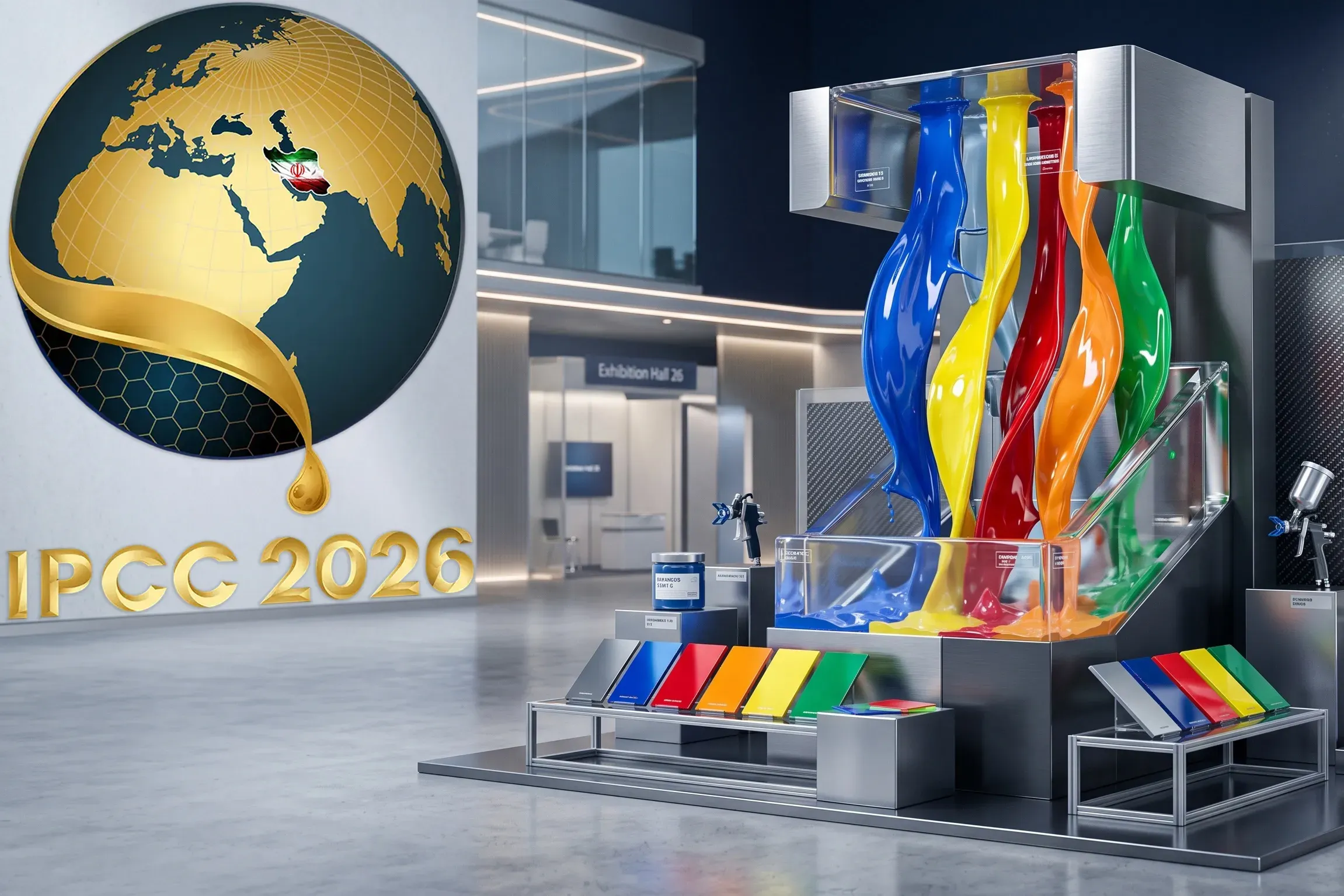
The 26th The International Exhibition of Paints, Resins, Industrial Coatings, Composite Materials will be held from December 6-10, 2026, at the Tehran International Permanent Fairground. The event will be organized by Banian Omid and will cover fields extending well beyond finished paint products.
When a specialized exhibition brings resin manufacturers together with producers of manufacturing machinery and companies active in industrial coatings, the breadth of the industry becomes more apparent.
Today, a can of paint represents the culmination of an entire chain of knowledge and technology, from raw material selection and formulation to manufacturing processes and quality control.
The evolution of the paint industry, from images on cave walls to modern industrial coatings, tells the story of how a simple need transformed over time. Initially, humans wanted to add color to a surface. Later, they wanted that surface to last longer. This seemingly simple requirement eventually gave rise to an industry that is now indispensable to construction and industrial projects.